
Garage Door Repair: Repair or Replace? How Tacoma Homeowners Decide
Most homeowners assume the decision comes down to the door’s age. It doesn’t. A 15-year-old door with one broken spring is almost always worth repairing, because springs wear out on a schedule and the door behind them is still sound. A 10-year-old door that’s needed three different fixes in two years is telling you something different, and the invoice total makes it obvious if you add it up. In this post we’ll show you the failure patterns that actually predict what a door will cost over the next 24 months, how Tacoma weather and house orientation fit into that math, and the one question that gets you a straight answer from any technician standing in your driveway.
If you’d rather hand this to someone who knows your equipment, call (833) 482-6153. We answer 24/7, and fast dispatch runs 7am to 7pm, Sunday through Friday.
Why Age Is the Wrong Place to Start
A garage door isn’t one object. It’s a door, a torsion or extension spring system, a track, a set of rollers, cables, hinges, and an opener. Those parts have wildly different lifespans. A steel door can hold its structure for twenty years or more while the spring above it cycles out in five to eight. Cables stretch and fray. Rollers flatten on their bearings. The point is that “the door is old” tells you almost nothing, while “this spring is done and these cables are showing wear” tells you almost everything.
What matters is sequence. When one spring fails, that’s a normal wear event. Repair it and keep going. When springs go, then cables start failing within a season or two, then rollers begin seizing, you’re watching a system reach the end of its service life together. That’s a repair bill that keeps growing, and it’s a dependable signal that the next 24 months will be expensive.
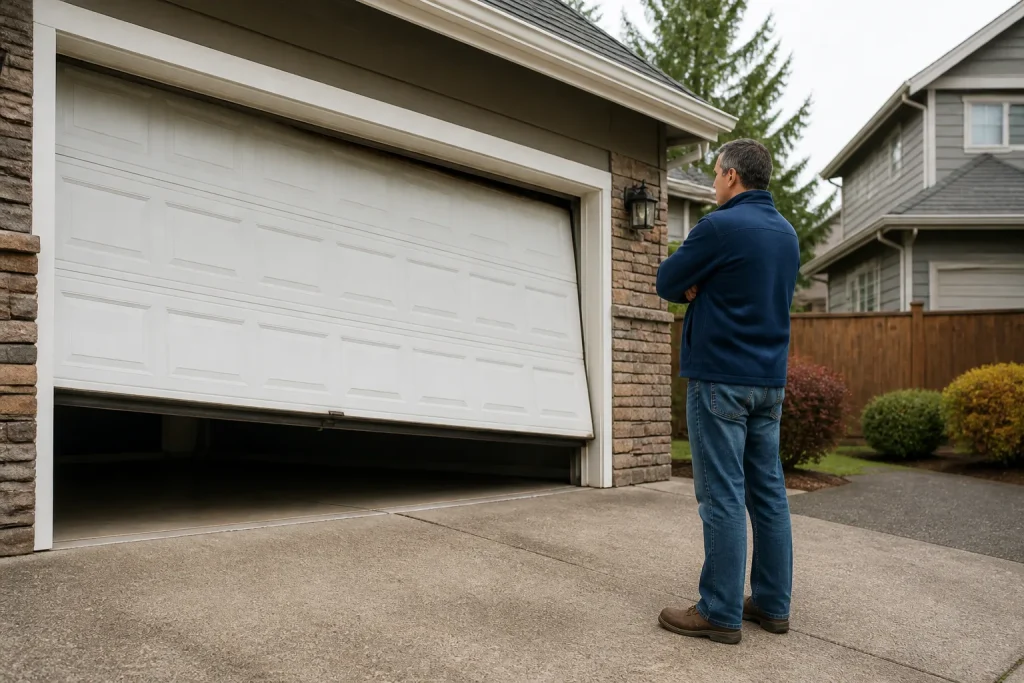
The math reverses when panels enter the picture. Springs and cables are replaceable parts. A bent or rusted-through bottom panel is structural, and once the lower sections start failing you’re patching a door that will never quite track or seal right again. That’s when replacement stops being the expensive option and starts being the honest one.
Here’s a quick way to sort it:
- One failed component, structure sound: repair. This is the common case.
- Two or more failures in 24 months, structure sound: repair is still likely fine, but ask what’s next in line.
- Springs, cables, and rollers all going within a couple of seasons: the system is aging as a unit. Get a replacement estimate alongside the repair quote.
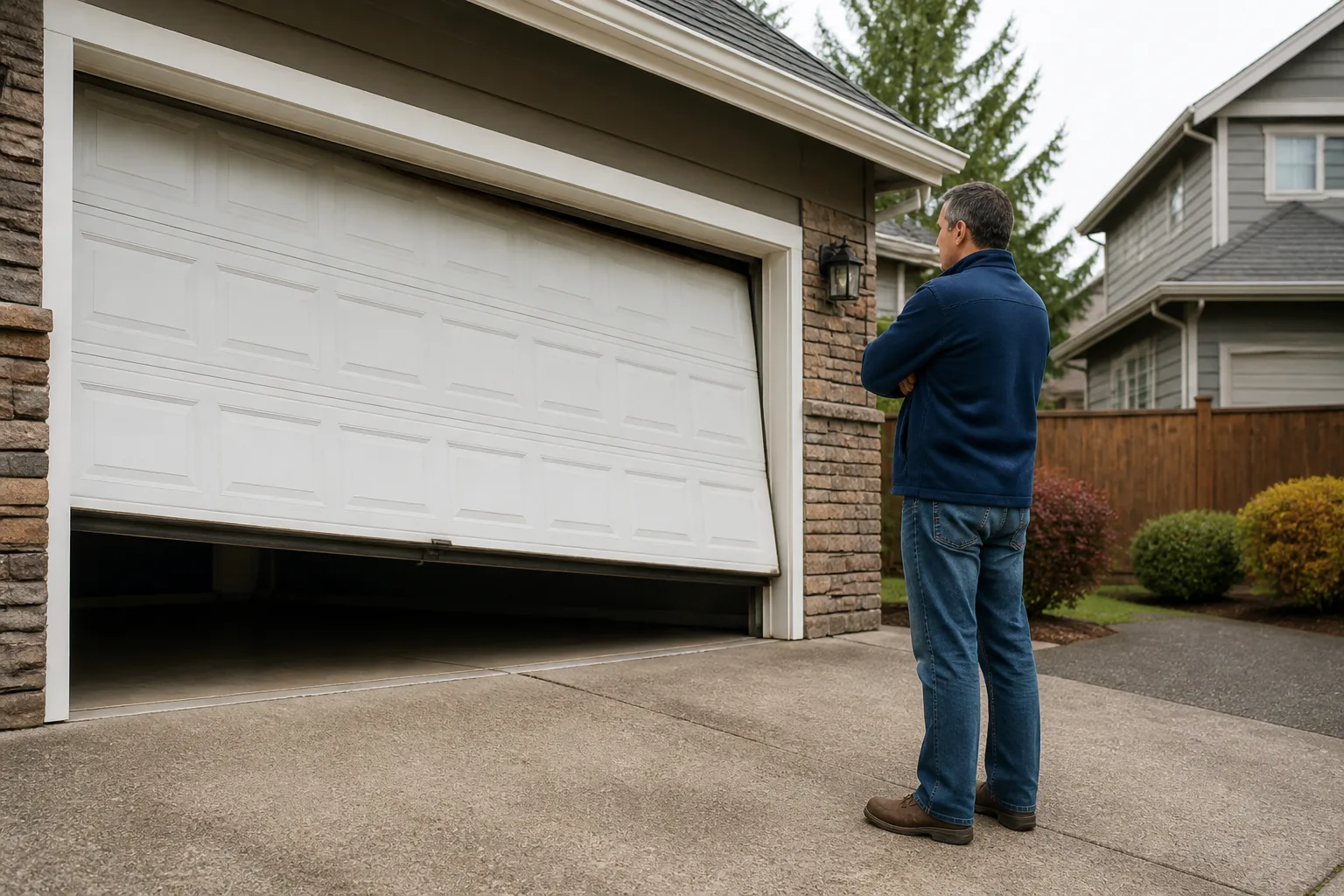
- Panel damage, bent track, or a door that won’t hang level: structural. Replacement usually wins the arithmetic.
What Tacoma Does to Your Door (and What That Changes)
Our local conditions push on certain doors harder than others, and it changes when the repair-or-replace line gets crossed. The freeze-thaw cycle does the most quiet damage. Spring mornings where the temperature climbs over freezing and drops back below it overnight drive moisture into seams, panel joints, and the bottom seal, then freeze it. Steel handles that expansion poorly over years. So do the hinges and the bottom weather seal. Composite and fiberglass doors ignore moisture but move with temperature swings, which is fine until the panels start to delaminate or crack.
Orientation matters just as much as weather. A north-facing garage door in Tacoma sits in shade through the winter, which means it stays damp longer after rain and dries out more slowly. That’s the door that rusts at the bottom edge first, and the bottom edge is often the panel that decides whether a repair makes financial sense. A south-facing door takes more thermal cycling and sun exposure, but it dries out between storms.
We bring this up because two houses on the same block can have very different decisions to make. A 12-year-old north-facing steel door with rust creeping up the bottom panel is a replacement conversation. The same door on the sun side, still sealing and tracking well, might have plenty of life left. Proximity to the Sound plays a role too, mostly through humidity that keeps a shaded door damp longer. We’d rather tell you which factor is working on your door than quote based on a calendar.
None of that changes the safety facts, and we’ll say this plainly: springs under tension can injure or kill someone who tries to take them on without the right tools and training. A snapped torsion spring is a job for a technician, not a weekend project. If you suspect cable damage, keep the door closed and call it in. When a door won’t move, we do.
The 50% Rule, With Real Tacoma Numbers
The standard guidance in the trade is that you replace rather than repair when the repair cost reaches about half the cost of a full replacement. That rule is useful, but only if you plug in real numbers instead of guesses. Here’s how the typical ranges work out in Tacoma, and what they mean for the decision.
| Job | Typical estimated cost | What it means for the decision |
|---|---|---|
| Single torsion spring replacement | Roughly $180 to $340 per spring | Well under the replacement threshold. Repair. |
| Matched spring pair (usually done together) | About twice the single-spring range | Still usually under the threshold on a structurally sound door. |
| New garage door installation | Roughly $1,200 to $3,500 depending on material and size | The 50% line falls around the middle of this range. |
Put those together and the 50% rule gets practical. On a $2,000 replacement, a repair that comes in under about $1,000 usually favors repair. A repair quote pushing past that on a door with multiple failing parts tips toward replacement. On a budget-friendly door, the threshold is lower, so a bundle of repairs crosses it faster.
Two honest caveats. First, these are typical estimates only, and a written estimate sets the final price. Second, the rule is a starting point, not a verdict. A door with a cosmetic dent and a fresh spring below the threshold in cash terms can still be worth replacing if you can’t stand looking at it. We’ll tell you what the numbers say and let you decide what matters to you. Call (833) 482-6153 for a free estimate on either path.
What Replacement Buys You That Repair Never Will
Replacement isn’t only about ending a repair cycle. It unlocks things a repair can’t touch, and those have real value in a Tacoma home, especially when the garage is your primary entry point and sits under living space.
- Insulation and current energy code for attached garages: older doors often have no insulation or degraded insulation. A new door brings a modern rating to the largest opening in the house, which matters in a climate with real heating seasons.
- Modern opener compatibility: a new door is sized and weighted for a current opener, so the door and operator work together rather than fighting each other. That’s true whether you’re staying with a LiftMaster unit or replacing with a Chamberlain model.
- Updated spring cycle ratings: standard springs are commonly rated around 10,000 cycles, while higher-cycle springs rated around 25,000 cycles are available. That’s years of extra service before the next replacement, and it’s one of the clearest long-term cost differences between a cheap replacement and a good one.
- Sealing and weather-tightness: new doors come with fresh bottom seals, side seals, and better panel alignment, which matters when you’re trying to keep a damp Tacoma winter out of a north-facing garage.
Repair can’t deliver any of that on an aging door. If you’re heading toward replacement, garage door installation covers how we measure, order, and set a new door for a Tacoma home so it fits the opening and the opener you’ve got. There’s no same-day promise there. Installation is measured first and scheduled, with a written price before any work starts.
Getting a Straight Answer From a Technician
Most homeowners never ask the question that would actually settle the decision. They ask “can this be fixed?” and they get a yes, because almost anything can be fixed. The better question is this: what will I spend on this door over the next two years if I repair it today?
That question forces a technician to look past the immediate failure and think about what’s likely next in line. If the answer is one spring and a roller or two, repair is the answer. If it’s a spring, a cable, and a bottom seal, and the panels are already showing rust, a good technician will tell you that answer out loud. So will we. We work on LiftMaster, Chamberlain, Genie, Raynor, Clopay, Amarr, Wayne Dalton, and Craftsman equipment, which means we’re not guessing at what your system needs or hunting for the right part. Garage door repair is what a lot of Tacoma doors need, and it’s a conversation, not a pitch.
A few things to listen for in that conversation:
- They inspect the whole system, not just the broken part, and can name what else is close to failing.
- They give you a written price before work starts, and the price doesn’t move once they’re into the job unless something new turns up and you agree to it.
- They explain the failure pattern, so you understand why they’re recommending one way or the other.
- They’re comfortable saying “replace” when repair is the worse financial call, and equally comfortable saying “just fix it” when the door has years left.
When to Call a Pro
Some of this you can assess from the driveway. You can see rust on the bottom panel and hear whether the door sounds strained. You can’t safely assess the springs, and a snapped torsion spring is a genuinely dangerous thing to have under tension, so call a pro before you touch a thing. We answer 24/7 and dispatch from 7am to 7pm, Sunday through Friday. If a call comes in outside those hours, we book it into the next opening.
If your opener is what’s acting up rather than the door, garage door opener repair is the right starting point. If you’re weighing repair against replacement across the whole system, we can look at both and give you the numbers side by side. And remember we’re a garage door specialist, not a general handyman adding doors to a long list, so the advice you get is from people who work on doors, springs, and openers every day.
Related services in Tacoma: if you want the full picture of what we handle, from spring replacement to emergency calls to new doors, the Tacoma Garage Door Repair Co page lays out the five core services and the brands we work on.
The Bottom Line
Two things are true at once: age is a poor reason to replace a door, and a door that’s failing in sequence is a reliable signal that replacement is the cheaper path over the next two years. Tacoma conditions make that more specific. Freeze-thaw mornings push moisture into seams, north-facing doors stay damp longer, and shade is often what turns a repairable door into a replacement conversation.
Use the 50% rule with real numbers. Repair a single failed component. Watch for sequence. And ask your technician the two-year question. Our technicians have up to 11 years of experience, and we work on the brands most homes already have, so you’re not the practice job.
If you’re in Tacoma and need help deciding, Tacoma Garage Door Repair Co offers free estimates, and the price is quoted and agreed before any work starts. Call (833) 482-6153 for a free estimate. We answer 24/7, with fast dispatch from 7am to 7pm, Sunday through Friday.
Frequently Asked Questions
Repair is usually the right call when a single component has failed and the door structure is sound, like one broken spring on a door that’s otherwise tracking and sealing well. Replace when multiple parts are failing in sequence or panels are damaged structurally. As a rule of thumb, replace when the repair reaches about half the cost of a new door. Call (833) 482-6153 for a free estimate on either path.
Most single-component repairs fall in the low-to-mid hundreds, and a single torsion spring replacement typically runs about $180 to $340, with a matched pair costing about twice that. It’s a per-spring price, and pairs are usually replaced together. A written estimate sets the final price before any work starts. Call (833) 482-6153 for an exact quote, and estimates are free.
Often, yes. Emergency service is a core part of what we do, not an add-on, and same-day appointments are frequently possible. We answer 24/7, and fast dispatch runs 7am to 7pm, Sunday through Friday. Call (833) 482-6153 and we’ll book the earliest opening.
No, not without your agreement. Your estimate is written and the price is agreed before any work begins. If we open the door up and find something new that changes the job, we’ll show you and get your approval first. That’s the whole point of a free estimate. Call (833) 482-6153 to schedule one, and we’ll put the price in writing.
Written by the team at Tacoma Garage Door Repair Co.
Need Garage Door Help?
Call Tacoma Garage Door Repair Co - the local pro we connect you with is licensed and insured, here with fast help in Tacoma.
(833) 482-6153